Why Storage Unit Organization Matters More Than Fitting Everything In
The unit does not fail because it is full. More often, it breaks down when the layout does not support the retrieval you actually need.
The Retrieval Problem Most Storage Plans Ignore
Storage frustration often starts at the door, not during packing. The unit can look neat on move-in day, then the first request for one item becomes a process of moving boxes, checking unlabeled sides, or clearing a door swing that was blocked by a bookcase.
A common pattern in storage projects is that boxes are sorted by room, the space is filled, and the plan is considered complete. A few weeks later, one document, one tool, or one seasonal item is needed, and the unit requires a second sort. This is where the layout starts to break down. The first rushed retrieval moves the original stack, and the next visit takes longer than the last.
This gets worse when visits are spaced out. Memory fades, labels become less useful, and the aisle narrows. The storage unit begins to feel less like a planned space and more like a pile with a lease.
Organize by Access Frequency, Not Just by Room
Room labels describe what is inside. They do not describe when you need it. That distinction is the first fix.
Assign each item to an access tier before it goes into the unit:
- First-access items: needed within the first few days to two weeks. Examples include bedding, daily clothing, work supplies, and a second set of kitchen basics.
- Mid-access items: needed within a season. Examples include holiday decorations, a second set of books, seasonal clothing, and room-specific décor.
- Long-access items: stored for months to a year or more. Examples include out-of-season equipment, spare linens, rarely used documents, and items with a low chance of being needed this year.
Once the tier is set, placement follows. Tier determines zone, zone determines stack height, and stack height determines whether the label can be read without moving other boxes.
How to Plan a Storage Unit Before Boxes Are Loaded
Plan the unit from the first retrieval date, not from the loading day.
Create a Simple Inventory Before the Move
The inventory is the retrieval map. It can be a notebook, a phone note, or index cards. The important part is that it exists before the boxes are loaded.
Use five fields for each box: box number, room or category, one-line contents, access tier, and a handling flag when needed. A simple entry such as 14, kitchen, plates and mugs, mid, fragile is enough. It tells the next person where the box belongs, what to expect inside, and how to handle it.
Build the list while packing. Last-minute inventories tend to miss items, duplicate numbers, and leave fragile boxes unmarked. If you use professional packing, the crew can apply these fields as boxes are sealed. If you are prepping items yourself, the steps in how to prepare belongings for storage before a move help speed the process without adding extra trips to the unit.
Match the Layout to the Expected Retrieval Date
Retrieval date changes the layout. A short-term unit should be built for frequent small trips. A long-term unit can reserve most of the space for stable, low-priority storage.
For short-term storage, keep the door zone active. Many households pull bedding, work items, and daily essentials during the first part of the move, so those boxes should be easy to reach.
For long-term storage, use the back zone for archive items. The door zone should remain small and reserved for items that must be available before the main storage period ends.
Seasonal items need calendar awareness. In New Orleans, hurricane-season prep, cooling equipment, and holiday décor often have retrieval windows tied to the season. If the length of storage is still unclear, review short-term versus long-term storage before locking in the layout.
A Practical Storage Unit Layout for Easier Access
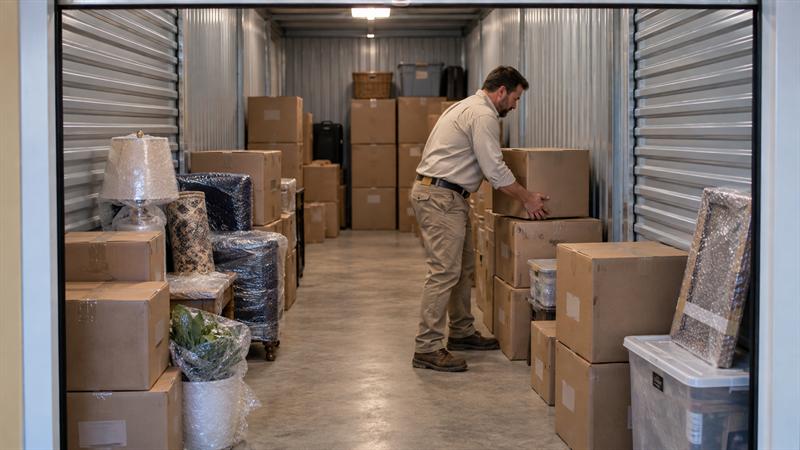
The layout works best when it is simple enough to repeat: door zone for fast access, middle zone for seasonal and moderate access, back zone for archive storage.
Use a Door Zone, Middle Zone, and Back Zone System
The three zones are based on distance from the door. The exact boundaries depend on unit size, but the order should not change.
Door zone, nearest the door swing:
- First-access items only.
- Light to moderate weight, unless a heavy item is also needed immediately and can be placed clear of the door.
- Stack low enough to reach without a step stool.
- Labels face outward so contents are visible at a glance.
Middle zone, beyond the door zone:
- Mid-access items such as seasonal clothing, extra books, room décor, and spare small appliances.
- Heavier boxes below lighter boxes.
- Labels still visible from the aisle.
- Stacking should remain stable and reachable.
Back zone, against the far wall:
- Long-access items such as out-of-season equipment, spare linens, and rarely used documents.
- Furniture placed flat against the wall.
- Least frequently used items farthest from the door.
- Higher stacking is acceptable when the stack is stable.
The tier drives placement. A light box marked long access belongs in the back. A heavy dresser marked first access can stay in the door zone if it does not block the swing.
Keep an Aisle Clear and Protect the Door Swing
Plan the aisle before loading, not after the first row of boxes is in place. The aisle is the working path for a hand truck, dolly, and the person carrying a box.
Keep the full door swing clear. No box, furniture leg, or leaning item should sit inside the path the door takes when fully open. This is the detail that most often gets lost on load day, and it is usually the first thing that slows retrieval.
If the entrance is narrow or has a ramp, make the aisle wider than you think you need. Tell everyone helping to load where the boundary is. If you are loading alone, a strip of tape on the concrete can mark the aisle edge and keep the boundary visible when the pace of the day is high.
What Should Go on the Floor, Shelves, and Along the Walls?
Placement should match weight, fragility, and sensitivity. Heavy things belong low, fragile things need clear access, and humidity-sensitive items need protection.
Heavy and Bulky Items on the Floor
Floor level is the right place for the heaviest and bulkiest items. Furniture, appliances, large totes, and heavy shelving are more stable on the floor and leave the aisle clearer for movement.
Place these along the walls rather than across the aisle. If a heavy item is also first-access, position it where it can be reached without blocking the door swing.
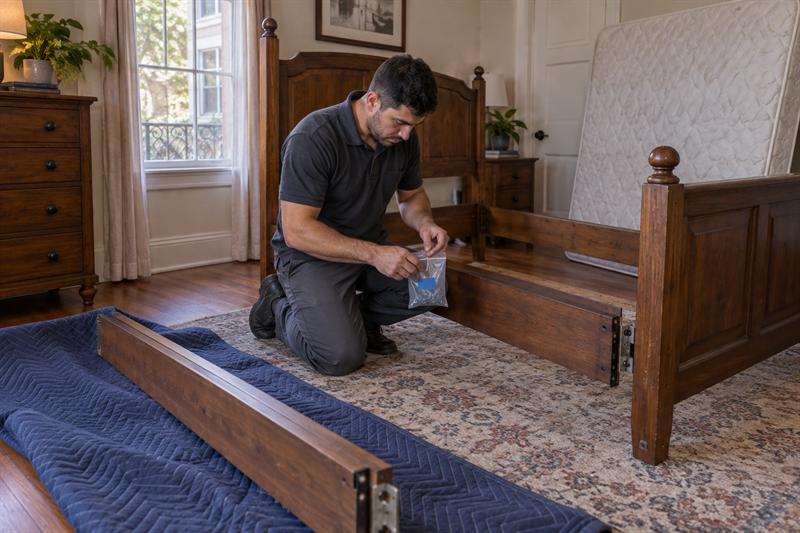
Disassemble what can be disassembled. Removing shelves, legs, and drawers reduces bulk, creates flat surfaces, and makes reassembly easier later. If the unit has built-in shelves or racks, use them for medium-weight items to keep the floor clear for larger pieces.
- Large furniture pieces such as sofas, dressers, bookcases, and dining tables.
- Appliances such as refrigerators, dryers, and small dishwashers.
- Heavy totes and bins such as garden supplies, tool storage, and sports equipment.
- Disassembled shelving and flat-pack items.
Fragile, Valuable, and Sensitive Items in Safer Positions
Fragile items should be wrapped individually and placed where they can be retrieved without moving heavy items first. Glassware, ceramics, framed art, and delicate décor belong in the door or middle zone, not buried under a stack.
Avoid stacking heavy boxes on top of fragile boxes. Space pressure makes this tempting, but added load can crack a box, shift its contents, or damage items that were wrapped correctly for transport.
Valuable and irreplaceable items, such as documents, jewelry, small electronics, or heirlooms, are often easier to protect in a lockable container. If the unit is opened often or the items are especially sensitive, a locked bin can keep them separate from routine box handling.
Humidity-sensitive items deserve extra protection in a climate like New Orleans. Paper, wood, leather, textiles, photographs, and electronics can be affected by sustained moisture and temperature swings. Keeping them off the concrete with cardboard, plastic sheeting, or a sealed bin adds a practical buffer. For storage lasting several months, a climate-controlled unit is often the better fit for these materials.
How to Label Storage Boxes and Build an Inventory That Saves Time
A labeling system is only useful when it is consistent. Consistency is what makes the inventory searchable by any household member.
Use a Consistent Labeling Format
Use the same format on every box. Different styles, missing fields, and pencil marks turn a useful system into a guessing game. Inconsistent labels encourage people to open boxes to check contents, which is the opposite of the goal.
The five fields are: box number, room or category, one-line contents, access tier, and handling flag when needed. The one-line description should be specific enough to be useful at a glance.
- Box number, matching the inventory list.
- Room or category.
- One-line contents description.
- Access tier: first, mid, or long.
- Handling flag when needed, such as FRAGILE, DOCS, ELEC, or HEAVY.
Label at least two visible sides. The top can disappear under a stack, and the side can face a wall. A marker that reads clearly from a short distance and resists smudging is the practical choice. In humid conditions, adhesive labels can peel, so a durable surface or a well-applied label matters.
The label on the box should match the inventory entry. If the two disagree, the plan is already broken before the first retrieval.
Add a Digital or Paper Map for Retrieval
After loading, take a photo of each zone. Mark box numbers on the photos or on a simple overhead sketch. The map should show where the door zone, middle zone, and back zone sit relative to the door.
The map should live where it will actually be used. A printed copy kept with the unit access details, a shared phone note, or a cloud document all work. The point is that the layout is recorded in a place that survives between visits.
- Take the photos while the load order is fresh.
- Update them after any addition, removal, or move.
- Share them with everyone who may access the unit.
An outdated map is worse than no map because it sends you to the wrong zone first.
Short-Term, Long-Term, and Seasonal Storage Placement
The same zone layout works differently depending on how often the unit will be opened.
Placement for the First 30 Days
The first month is usually a period of small trips. People retrieve a charger, a book, a spare sheet, a tool, or a missing kitchen item, often more than planned. The door zone should be built for those repeated short visits.
Keep first-access boxes easy to reach, without requiring a step stool or a full aisle reset. If a box is being used frequently, it belongs near the door, not high in the middle of the unit.
- Bedding and daily clothing for the first week or two.
- Kitchen basics if the new kitchen is not yet set up.
- Work supplies, chargers, and small electronics still needed daily.
- Toiletries and daily-use personal items.
Phased moves and renovations change the pattern. The household may be making multiple trips over several weeks rather than one large unpacking. Planning the door zone for that pattern keeps the layout useful. For coordinated move and storage plans, it helps to understand how moving and storage services work together before the load order is finalized.
Placement for Long-Term and Seasonal Items
Once storage extends beyond the immediate move period, the priority shifts from speed to stability. Items that are not needed for weeks or months belong in the middle and back zones.
Group seasonal items by retrieval season. Holiday décor can be clustered by holiday, cooling equipment by summer, and storm-prep items by hurricane season. Grouping related items makes one retrieval trip cover the full set instead of scattering boxes across zones.
In New Orleans, storm-prep items deserve a special note. Tarps, flashlights, batteries, and waterproof document cases may be stored for months but can become first-access during a weather event. If the season is approaching, move those items to a more reachable zone before the event, not during it.
For storage lasting many months, climate becomes a real factor. Climate-controlled units hold temperature and humidity within a tighter range, which is often a sensible fit for paper, wood, leather, textiles, and electronics. The choice depends on the materials, the expected storage length, and the available unit size.
Common Storage Unit Mistakes That Make Retrieval Harder
Most retrieval problems are not dramatic. They are small layout choices that add delay and handling risk on every later visit.
Blocked Doors, Missing Aisles, and Unlabeled Boxes
The pattern is usually compounding. The door is clear on load day, then a bookcase is leaned against the frame. The aisle is wide early, then a second delivery closes it down. One box is labeled, the next is not, and by the next visit the unit no longer matches the plan.
- Blocked door or swing: the first thing that slows retrieval, because the blocker often needs to be moved before the requested item is reached.
- No defined aisle: load-day order becomes ambiguous after additions, donations, or reopens.
- Unlabeled boxes: retrieval turns into an open-and-check process, adding time and handling risk.
- Heavy boxes on fragile boxes: the damage risk moves to the most vulnerable items.
- No inventory or map: memory replaces a usable plan, and memory fades.
- Everything boxed: heavy furniture and appliances may be more stable and space-efficient on the floor.
- Restricted items: flammables, perishables, live plants, unsealed fuel, and certain chemicals are commonly restricted by facility rules.
Each mistake can look minor at loading time. Together, they turn a short retrieval into a reorganization session and increase the chance of damaged boxes, scratched furniture, or missed items.
When Professional Packing or Moving Support Helps
Professional packing helps most when the storage plan must be executed accurately under time pressure.
Professional Packing for Retrieval Planning
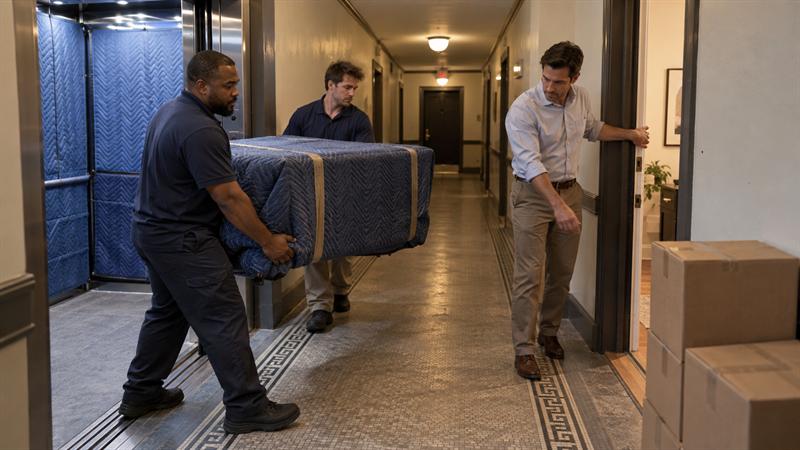
The value of professional packing in a storage move is not just wrapped boxes. It is consistent labeling, inventory support, and zone placement completed before the items leave the origin address.
A crew working from the access-tier plan can assign boxes to zones, apply labels, and load in the order that matches the storage layout. That is especially helpful when the move and storage happen on the same day and the access window is short.
If any of these apply, a coordinated packing and storage pass is usually the faster way to keep the unit usable:
- You are storing fragile, high-value, or humidity-sensitive items and need consistent wrapping and placement.
- The move and storage window is tight, so labels and inventory entries must be completed before the truck leaves.
- You have more boxes than can realistically be inventoried, labeled, and zoned in one evening.
- You want the unload sequence to match the storage layout instead of solving the layout after the truck is parked.
If that list sounds familiar, the layout should be settled before load day, not after the unit is full.
For a small number of non-fragile boxes, self-packing can work well. The deciding factor is whether the inventory, labels, and zone assignments can be completed accurately before the access window closes.
Moving, Storage, and Protective Supplies Working Together
Storage organization continues the move. Wrapping, padding, box type, and corner protection used in transit carry into storage. An item that is protected for the drive but stacked without a plan can still reach the storage unit at risk.
At H and U Express Moving, hourly moving packages include protective supplies. That means the same protection used during the move can extend through the storage setup, without separate sourcing of bubble wrap, furniture blankets, or corner guards for a coordinated plan.
When move and storage are handled together, the load order can be aligned to the zone plan. The back zone is loaded first, the middle zone next, and the door zone last, so the final arrangement in the unit matches the layout rather than the order in which items happen to be unloaded. For large or fragile pieces, the same service team can support both the move and the placement decision.
That is the H and U Express Moving approach: align the moving package, protective supplies, packing plan, and storage zone layout before the first box is loaded. The goal is a unit that is easy to open, easy to search, and easy to leave in the order it was built.
Key Takeaways
The method comes down to five practical steps:
- Sort by access tier before loading.
- Use the door, middle, and back zone layout matched to the retrieval date.
- Clear the aisle and door swing before loading begins.
- Label every box with a consistent five-field format and keep a master inventory.
- Place heavy items low, fragile items in reachable positions, and humidity-sensitive materials with added protection.
Conclusion
The real problem is not fitting everything into storage. The problem is building a unit that can be reopened without becoming a second move. Without an access plan, the first retrieval can disrupt the layout, the next retrieval can take longer, and fragile or sensitive items can be exposed to more handling than they need.
This pressure continues when the aisle narrows, labels fade, and the inventory is no longer used. The result is more time spent pulling items out, more handling risk to fragile materials, and a storage unit that is harder to exit than to enter.
H and U Express Moving can help with this by coordinating the move, storage, packing, and protective supplies in one plan. The access tiers can be set before loading, the zone layout can be matched to the expected retrieval date, and the load order can support the storage plan instead of defeating it. The practical next step is simple: build the access-tier list, then bring that list to H and U Express Moving so the storage layout is confirmed before the truck loads.
Frequently Asked Questions
What Should I Not Store in a Storage Unit?
Flammables, perishable food, live plants, unsealed chemicals, and items that can leak or produce mold are the categories most facilities restrict. Gasoline, propane, lighter fluid, paint thinner, opened containers, fresh or frozen food, cut flowers, potted plants, and unsealed solvents are typical examples.
The restriction exists because these items can create fire, mold, odor, or moisture problems that affect the unit and nearby items. A leaking container can damage cardboard, fabric, and documents, while flammables are typically restricted because they raise fire risk.
Facility rules vary, and the rental agreement usually lists what is allowed. Items near the line often depend on the specific facility’s permitted-item list, because the consequences of a violation can outweigh the convenience of storing the item in the unit.
How Do I Keep a Storage Unit Organized After the First Load?
The first load is the simplest version of the problem. After that, every addition or move can weaken the plan if there is no maintenance rule.
- Put new boxes in the back zone first so the door zone stays reserved for immediate needs.
- Update the inventory and zone map after any move, addition, or removal.
- Do not leave boxes in temporary positions without updating the label or map.
Household changes also shift the plan. A new baby, a new job, or a renovation phase can turn a mid-access item into a first-access item. Rechecking the tiers before adding new boxes keeps the zones aligned with how the household is actually using the space.
Is It Worth Getting Professional Packing for a Storage Unit?
Yes, when the plan is too detailed for the available time. The value is not only in wrapping boxes. It is in completing the inventory, labels, and zone placements before move-day pressure takes over.
Professional packing works best with large volumes, fragile or high-value items, tight access windows, or households that need the storage layout to match the unload sequence. For a small number of non-fragile boxes, self-packing can be enough if the five-field labels and inventory are completed consistently.
The practical distinction is whether the labeling and zone setup can be finished accurately before the truck leaves. If that is true, self-packing can work. If the timeline is tight or the contents are delicate, professional support addresses one of the most common causes of storage disorganization.
Should I Use Climate-Controlled Storage in New Orleans?
In New Orleans, climate-controlled storage is often the practical choice for paper, wood, leather, textiles, photographs, and electronics. The local climate combines heat, humidity, and seasonal swings, which can affect those materials over a multi-month period.
For durable, non-sensitive items, such as sealed plastic bins, hard-surface household goods, painted metal tools, and sealed appliances, a standard unit is often sufficient. The extra climate control is most useful when the stored material is sensitive to moisture and the storage period is long enough for conditions to matter.
The decision separates cleanly into material, duration, and unit size. A few sealed bins stored briefly are a different situation from a box of documents or a set of wood furniture stored through a humid season.
How Do I Organize a Storage Unit If I Only Have Two or Three Days of Access Time?
With only a short access window, the unit needs to be organized on the first load. The plan should exist before the truck arrives because there is no second visit to fix labels, move a bookcase, or widen the aisle.
- Finish the inventory and zone plan at the origin address.
- Apply labels while boxes are being packed, not while standing in the unit.
- Agree on the aisle and door-swing boundary before the first box is unloaded.
If completing the full plan before moving day is not realistic, the crew can still build the load order from the access tiers, zone map, and inventory list. Bringing those materials to H and U Express Moving before move day gives the crew a reliable sequence to work from, so the storage unit is set up in the order the household actually needs.