Quick Answer: A moving box label stops working the moment it only names the room. A simple system that keeps unloading fast uses one primary label per box with four parts: destination room, contents category, box number, and a handling note when needed, all placed on visible faces.
Why Moving Box Labels Matter More Than Packing Supplies
How Labels Support Loading, Unloading, and Unpacking
A label is not just a sticker on a box. It is a key piece of information that serves the packer, the mover, and the person unpacking at the new home. Without it, too many handoffs become guesses. With it, each person can see what to do without opening the box or calling back to the kitchen.
- Packing: you group by room and category instead of stuffing items into the nearest open box.
- Loading: movers can see the room grouping and fragile contents at a glance.
- Unloading: boxes go to the right rooms with fewer stops to ask, “What is in this one?”
- Unpacking: you know what to look for before you break the tape.
How Labels Reduce Moving-Day Decisions
Moving day is a long chain of small decisions, and every unlabeled box adds one more. Labels turn those decisions into a read-and-place action instead of a pause-and-open search. The effect shows up most when the truck load order does not match the order your new home will need rooms.
In residential moves, label visibility drops fast once boxes are stacked, taped, and shifted. A label readable only from one angle goes useless the moment the box rotates. Placing labels on multiple visible faces keeps the system working from the first floor to the truck bed to the new hallway.
The Best Moving Box Labeling System
Use a Consistent Format: Room, Category, and Box Number
The system that holds up across a full household is short enough to write in ten seconds and specific enough to prevent guesswork. Use one format on every box:
- Room: Kitchen, Bedroom, Bathroom, Office, Living Room.
- Category: Glassware, Linens, Tools, Spices, Cords, Decor.
- Box number: Kitchen 1, Kitchen 2, Bedroom 4.
- Handling note (when it applies): Fragile, Heavy, No Stacking, First Night, Priority.
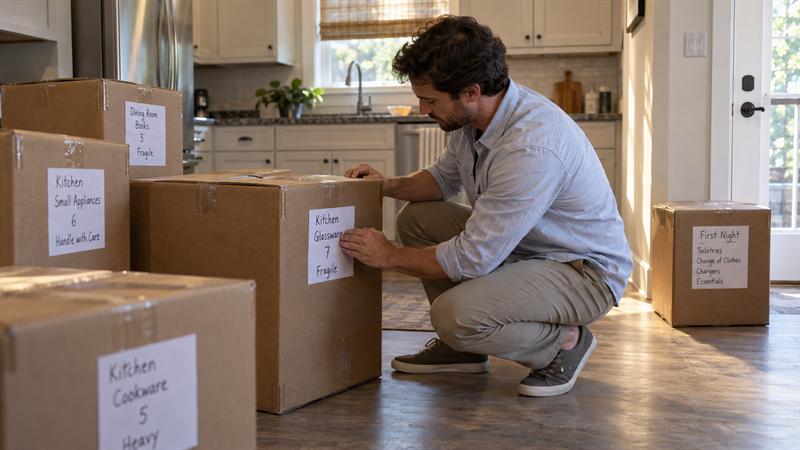
Example: Kitchen, Glassware, Box 7, Fragile. Example: Bedroom, Linens, Box 14, no note. Consistency across every box matters more than fancy stickers or a color-coded scheme.
Label by Destination, Not by Packing Location
Label the room where the box belongs in the new home, not the room where you are packing it. A box assembled in the garage often holds office supplies, outdoor gear, and seasonal storage items all at once. A destination label keeps it from ending up in the first open room at the new address.
This is where moves get messy: a box that says “Garage” tells the unloader nothing about where the contents should go. Label by destination and the placement question goes away before someone has to ask it.
Assign Priority Before Labeling
Decide which boxes you need on day one before you write the label. If you wait until unloading to sort out what is urgent, essentials may end up buried under a stack of “misc” boxes you will not open for days. Mark them First Night or Priority while you still know what is in the room.
Keep those boxes separate from general room stacks when possible. Everything else can wait until the new home has a floor plan to work from.
What to Write on Each Moving Box Label
Minimum Information Every Label Should Include
A label needs enough detail that someone who did not pack the box can identify its contents and destination without opening it. The minimum that works:
- Destination room: where the box belongs in the new home.
- Contents category: the type of items inside.
- Box number: a way to point at one box among several from the same room.
- Handling note: fragile, heavy, no stacking, first night, or priority.
“Kitchen” alone is not a label when you have five kitchen boxes. It tells the unloader where the box goes but nothing about what is inside or which of the five it is.
Recommended Label Examples by Room
Specific categories are what make a label actually useful. Here is what works by room:
- Kitchen: Glassware, Dishes, Spices, Small Appliances, Cooking Tools, Cleaning Supplies.
- Bedroom: Clothes, Linens, Shoes, Beauty Items, Seasonal Bedding.
- Bathroom: Toiletries, Towels, Medicine, Linens, Cleaning Supplies.
- Living Room: Decor, Media Cords, Entertainment Components, Guest Blankets.
- Office: Files, Cords, Office Supplies, Equipment, Paper.
- Storage: Seasonal Items, Outdoor Gear, Tools, Holiday Decor, Bulk Supplies.
“Kitchen, Small Appliances, Box 3” points you to the coffee maker without opening the other kitchen boxes. “Kitchen, Misc” does not.
How to Mark Fragile, Heavy, and Essential Boxes
The word “Fragile” loses much of its meaning when it appears on every box. A label that names the material and the handling concern tells the handler what to watch for in a way a generic warning does not.
- Glassware: dishes, stemware, mirrors, glass tableware.
- Electronics: towers, speakers, monitors, equipment that needs padding.
- Artwork: frames, canvases, mounted pieces.
- Heavy: books, tools, media components, dense items.
- No Stacking: boxes with uneven weight or breakable contents near the top.
Essential boxes get a First Night or Priority mark so they skip the general queue. If the contents need more than a label to survive the move, the fragile packing steps come before the label, not after. A label tells the handler what to watch for, not how to protect the item. The padding, fill, and taping inside the box do that.
How to Place Moving Box Labels So Movers Can Read Them
The Best Sides for Box Labels
A label is only as good as its visibility at the moment someone needs to read it. That moment is usually not when you are writing it. It is when the box is stacked in the truck or sitting on a pile at the new home.
- Top: visible when the box is stacked or being lifted.
- Front side: visible when the box sits on the floor in a row.
- Second side: a backup when the stacking order changes.
The practical move is to put the main label on one visible side and add a short duplicate tag or second label on the top. If the box will be shifted more than once between your current home and the new one, two visible faces beat one.
How to Keep Labels Visible During Loading
Keep labels clear of tape runs, packing paper flaps, and strap paths. A label under tape is a label that has disappeared. Packing paper shifts. Straps cover the face you planned on.
Apply the label after the box is fully sealed and taped. Use a marker that stays sharp after a few hands have grabbed the box. If you use sticker labels, press them flat so edges do not lift. A common reason a label is unreadable at unloading time is that it was written before the box was finished being prepped for the truck.
Common Label Placement Mistakes
These are the placement errors that turn a working system into a pile of mystery boxes at the new home:
- Label only on the bottom: nobody usually reads a box upside down during unloading.
- Label under tape: the information is hidden when you need it most.
- Tiny handwriting: forces someone to crouch, open the box, or call for the packer.
- Only one hidden side: one rotation makes the label invisible.
- Label on a flap: flaps shift, peel, or get caught during loading.
Write on a flat face. Keep it away from tape. Add a second mark on the top if the box will move more than once.
How to Label Boxes for Moving Day
How Labels Help Movers Load the Truck
Labels give movers a fast reference during loading. They do not tell the crew how to stack the truck or which boxes go on the floor versus higher positions. What they do is cut out the pause where someone stops to ask “what is in this?” before deciding where it goes.
Box numbers do the real work here. When you need the small appliance box moved to the front of the truck for easier unloading, “Kitchen 4” is faster than describing the box and hoping the handler found the right one.
How Labels Help With Unloading and Room Placement
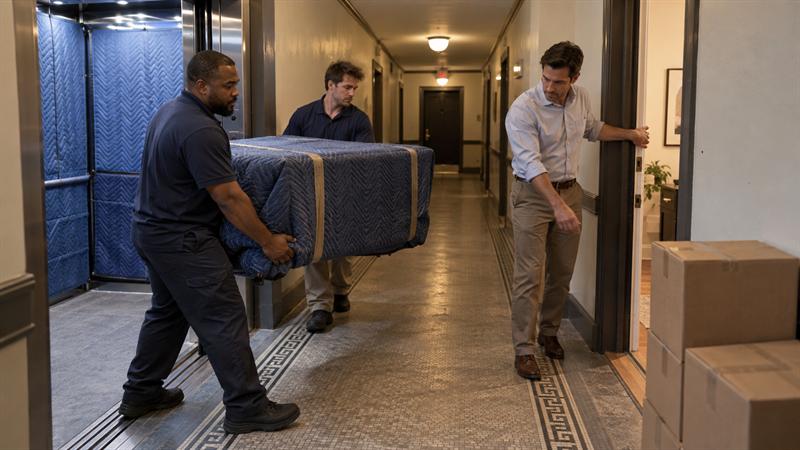
Unloading is where labels earn their keep. The truck arrives, boxes come out, and someone has to decide where each one goes. A label that says “Bathroom, Linens, 2” lets the unloader put the box in the bathroom without asking, guessing, or opening it to check.
Group boxes by room as they leave the truck whenever the space allows. This keeps the unloading flow orderly and helps the household settle into the new place faster. For a clearer picture of how the day plays out from the movers’ arrival to the final walkthrough, see what to expect on moving day. Labels do not control the load. They control the placement decisions that happen after the truck stops.
Labeling Boxes for Immediate Access
First night boxes need a label that separates them from the room stacks so anyone in the household can find them without asking who packed what. Mark the box First Night, Priority, or Essentials and keep it away from the general room piles.
- Toiletries, towels, and basic bathroom items.
- Medicine, first aid supplies, and daily prescriptions.
- Phone chargers, cords, and basic power accessories.
- A sheet set, a pillow, a change of clothes, and shoes.
- Coffee, basic cleaning supplies, and trash bags.
- A small kitchen basics box if you will make a meal that night.
If you need more than one box for day one, number them in the order you will open them. Box 1 is the one you grab at 9 p.m. when you need a toothbrush. Box 2 is the one you find at 10 when you realize you left the coffee maker in another stack.
How to Label Boxes for Storage
Storage Box Labeling for Short-Term Moves
Even a two-week gap between moving and grabbing a box is enough for the contents to become a blur. A room and category label keeps the box identifiable without opening it.
- Destination room or storage area.
- Contents category.
- Box number.
- Estimated retrieval window, if you already know it.
If you expect to need the box within the first week at the new home, add First Needed or Early Access to the label. That saves you from pulling through the unit looking for one thing.
Storage Box Labeling for Long-Term Organization
Boxes that will stay sealed for months need more detail than a quick room name. The label has to carry enough information that someone can find the box without knowing the order you packed them in.
- Room of origin.
- Contents category.
- Box number.
- Date packed, useful when you manage multiple storage cycles.
- Seasonal or event note: Holiday, Winter Gear, Sports Equipment.
“Storage, Outdoor Gear, 11” gets you to the camping box in seconds. “Seasonal Stuff” gets you a long unit search. The longer the box sits, the more specific the label needs to be.
Creating a Simple Storage Inventory
A one-page inventory turns your labels into a reference you can check without walking the unit. It does not need to list every object. It needs to connect the box number to the room, category, and any handling note.
Use a repeatable line: Room, Category, Box number, Handling note. Example: Bedroom, Linens, 14, Wash before use. If a box needs climate-controlled space or fragile handling, note that on the same line.
Write the inventory before the boxes leave the house. Once they are in the truck, the room and category details get harder to recall. A short list also helps when the move includes both a drive and a storage stop, because you already know where each labeled box belongs when it reaches its final location.
Common Moving Box Labeling Mistakes
Labels That Are Too Vague
“Misc,” “Stuff,” “Various,” “Odds and Ends.” None of these words help the unloader, the mover, or the person trying to find a specific cable. They create the same frustration as no label at all.
When a first night turns into a search through four boxes labeled “Misc,” the cost is time you should be spending setting up the new home. The fix is to use the simplest specific category you can name. If the category is too broad, split the box. A box with mixed contents is often where a label system first breaks down.
Using “Fragile” on Every Box
When every box says Fragile, the word tells the handler nothing. It does not identify which box has stemware, which has a framed painting, and which has a stack of books that is heavy but not breakable. The warning loses its signal value the moment it is universal.
In moves where every box carries the same marking, fragile items often get the same handling as everything else because there is no visual distinction. Mark only the boxes that contain breakable or high-care items, and name the material on the label so the handler knows what to watch for.
Hiding Labels Under Tape or Packing Paper
A label you cannot see is a label that does not exist. Tape, packing paper, and straps cover the exact face you planned on, especially when the box rotates during loading. This happens most often when the label is written before the box is fully sealed or when the taping path crosses the label area.
The fix is to label after sealing and to keep the writing clear of tape lines and flap edges. If the label gets buried, the unloader has to stop the flow, check the box, and figure out where it goes. Every one of those pauses adds up over a full move.
Labeling Without a Numbering System
Room and category labels identify the contents. Numbers identify the box. Without numbers, you are describing a box to find it: “the glassware one, second from the left, near the top.” With numbers, it is “Kitchen 7.” The difference is the time saved and the confusion avoided.
Numbers also carry into storage. When a box has been in a unit for three months and you need to verify it against an inventory list, “Box 14” is faster than “the linens one I think I packed in March.”
When DIY Labeling Is Not Enough
Signs Professional Packing May Help
If your packing area already looks like a forest of half-labeled boxes and you are running out of time, professional packing can be the faster path forward. The label problem is not really about handwriting. It is about maintaining one format across rooms, floors, and multiple packers while also wrapping, filling, and taping. Look for these signs:
- Each room has a different label style, and no one can read the other room’s system.
- Fragile items are wrapped, but the boxes do not say what is inside.
- The packing timeline is compressed and the movers arrive before you finish.
- Storage is part of the move and you need an inventory that actually makes sense at drop-off.
When those signs are present, the move needs a packer who enforces the label system while handling the materials. The label, the wrapping, and the inventory are one process, not three separate tasks.
When Professional Packing Makes the Most Sense
Professional packing fits best when the move includes fragile contents, a large volume of boxes, or a schedule that leaves no room for a second pass to fix labels. It also makes sense when the label system needs to match the packing work instead of being slapped on after the boxes are closed.
- Kitchen glassware, stemware, dishes, and small appliances.
- Artwork, mirrors, framed pieces, and decorative objects.
- Electronics and equipment that require padding before they go in a box.
- Large household moves where consistency across dozens of boxes is hard to maintain by hand.
- Storage moves where the household needs a clear, accurate inventory at drop-off.
Professional packing does not replace your label plan. It executes it across the whole home and adds the materials and handling that help keep fragile items protected during transport.
How H and U Express Moving Supports Labeling and Packing
At H and U Express Moving, the packing and label system is part of the moving plan, not an add-on you figure out the night before. The company serves New Orleans residential customers with home moves, professional packing services, short-term storage, long-term storage, and handling for large or fragile items.
The published hourly moving packages include protective supplies, so the household is not rushing to a store for tape, paper, and boxes the morning movers arrive. If the move includes a fragile kitchen, a compressed schedule, or a storage stop, the label system and the packing work can align in the same visit. The boxes leave the home organized, labeled, and ready for loading. That setup helps keep unloading and first night from becoming a search through mystery boxes.
Frequently Asked Questions About Moving Box Labels
What Is the Easiest Way to Label Moving Boxes?
Use one format on every box: destination room, contents category, box number, and a handling note if it applies. “Kitchen, Glassware, 7, Fragile” is faster to read than “Kitchen stuff” the moment the box is out of the truck. The system works because every box follows the same pattern, so anyone in the household can sort without asking who packed it. Keep the label on a visible face and away from tape runs.
Should Boxes Be Labeled by Room Only?
No, not past the first box in each room. A single bathroom box labeled “Bathroom” works. Five kitchen boxes all labeled “Kitchen” do not. The category and number are what let you pull the glassware box without opening the dish box. Room-only labeling may save a moment during packing, but it can add searching during unloading, and those pauses can build across a full move.
How Should Fragile Boxes Be Labeled?
Name the material and the handling concern instead of writing “Fragile” on every box. “Glassware, No Stacking” tells the handler more than “Fragile” does because it identifies what is inside and how to position the box. “Framed Art, Handle by Base” is even more specific and can help keep a painting from being set on its edge. The label is only as useful as the packing inside it, so the wrapping and fill come first, and the label tells everyone else what they are working with.
Do Movers Use Box Labels When Unloading?
Yes, labels cut down on placement questions during unloading. A mover or family member standing in the hallway can read “Bathroom, Linens, 2” and put the box where it goes without pausing to check contents. The label does not tell the crew how to stack the truck or which items go on the floor. It identifies the box, groups it by room, and lets the unloading sequence run without stopping to search through piles for the one box holding the coffee maker.
Can I Use a Moving Box Label Template?
Yes, and it is the fastest way to keep the system consistent when more than one person is packing. Fix the order: destination room, contents category, box number, handling note. If a box has no handling note, leave that field blank rather than rearranging the order. Print a small template or just practice the format on the first three boxes so the rest of the household follows the same pattern. Consistency between packers is what makes the system work at the new home.
What Should a First Night Box Be Labeled?
Mark it First Night, Priority, or Essentials, and list the main contents so you know what you are looking for. “First Night, Essentials, Toiletries and Medicine, 1” tells everyone the main contents and that it belongs at the top of the unloading list. Keep it separate from the room stacks so it is not buried under a pile of “Misc.” If the box is getting too large, split it into a comfort box and a kitchen basics box so neither one has to be fully unpacked before you find the thing you need at 10 p.m.
Key Takeaways
- Use one label format on every box: destination room, contents category, box number, handling note.
- Label by the room where the box belongs in the new home, not where you packed it.
- Place labels on visible faces and keep them clear of tape and packing paper.
- Name the material on fragile boxes instead of marking every box with the same warning.
- Separate first night boxes so essentials are available before general unpacking starts.
- Add more detail and a simple inventory when boxes go into storage.
- If the label system is breaking down across rooms, professional packing can help keep it consistent and complete.
Conclusion: Turn Moving Box Labels Into a Simple Moving System
The problem with moving boxes is rarely a lack of boxes or tape. It is a label system that does not survive the trip from the kitchen floor to the truck bed to the new hallway. Room-only labels, hidden under tape, or buried in a stack of “Misc” boxes turn unloading into a search and first night into a scramble for the toothbrush and the coffee maker.
Left unaddressed, that confusion can carry through the first few days in the new home. Fragile items can get less careful handling because nobody can tell which box needs it. Storage boxes can become unfindable a month later because the inventory was never written down. The fix is a four-part label applied consistently, a numbering system that survives the move, and a clear separation between day-one essentials and general room contents.
Start with the room-by-room preparation checklist before you open the first box, and label as you pack rather than batch-labeling at the end. If the fragile rooms are still open, the timeline is compressed, or the storage step is part of the plan, H and U Express Moving is the next step. Published hourly packages with protective supplies, professional packing, home moves, short-term and long-term storage, and handling for large or fragile items help keep the label system, the wrap, and the load connected from the first box to the last. The boxes leave your home organized and labeled, so the new home starts with fewer questions.